I am the youngest of nine children and have six brothers and two sisters. Mum and Dad had pretty well given up on parenting when I was growing up. Our family was really poor and we lived on one of roughest estates around, where there was a lot of crime and violence. In my last years at school, I was knocking around with men in their 30s who were hardened addicts and alcoholics. They used me to climb through windows so that they could burgle houses. I thought drinking alcohol was the answer to all my problems.
I left school aged 15 with no qualifications. I was introduced to amphetamine when 17, and two years later was injecting the drug. I soon got Hepatitis C from sharing needles and had Interferon treatment which took me to some dark places. I served my first prison sentence aged 21. I later started injecting heroin and was sentenced to prison for burglaries and shoplifting. Back out to using, then back in prison again. The same cycle continued for a decade or so. I didn’t know how to change. I was on methadone for nigh on 20 years.
In 2002, I hit an artery when injecting drugs into my groin and developed endocarditis, an infection of my heart valves, which caused sepsis. All my organs were shutting down. I was in hospital for the next seven weeks, slipping in and out of consciousness. I recovered, but as the years passed by my life got darker. I had deep vein thrombosis and contracted Hepatitis C again. I started using all sorts of drugs with my heroin and crack, because all I wanted was oblivion. I was stabbed in the neck and face, due to my drug dealing, but was saved by a lady calling an ambulance. I was back in prison soon after and was told that the person who had stabbed me was there also. He was offering £500 for anyone who would do me in. After I left prison, I just wanted to die, as I was living with so much guilt. I tried to kill myself twice, but was found unconscious.
I was homeless, housed in temporary accommodation. My prescription changed from methadone to Buvidal, for which I received monthly injections. An SMS worker got me into Hafan Wen Detox Centre and later into Penrhyn House. I was filled with fear when I entered Penrhyn. I met Saffron Roberts and she told me her story. I thought: ‘Hang on a minute, she used to be just like me. Look at the smile on her face, and the way she’s carrying herself and talking.’ I thought I’d try this recovery thing, and if it didn’t work I’d kill myself.
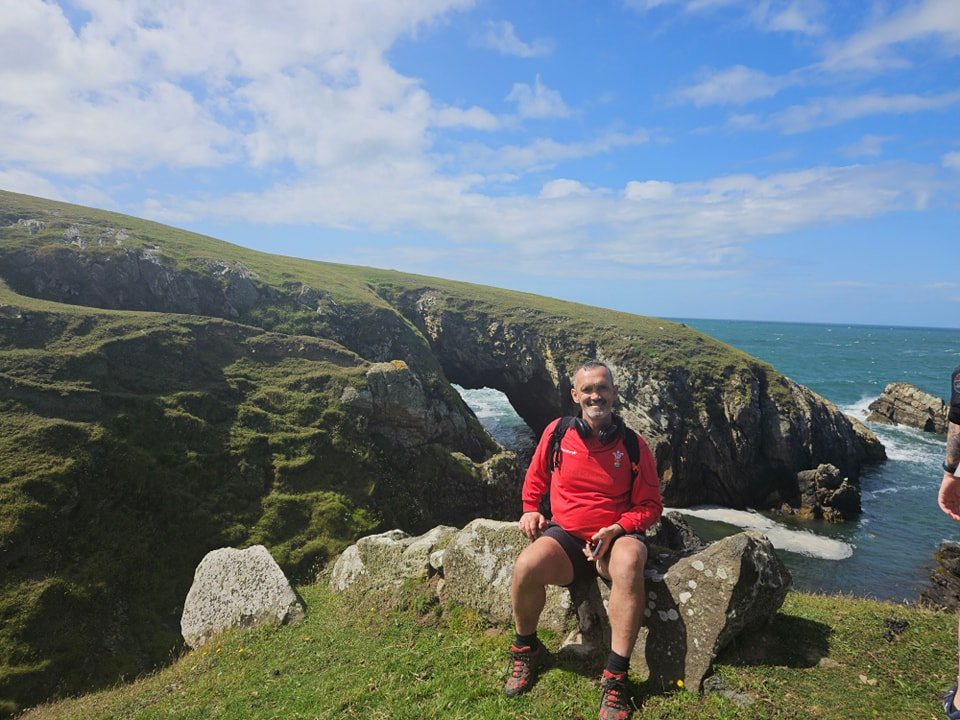
Talking to Saffron (Saff) and Tony Gizzi, who had also been to the same depths as me, played a significant role in helping me get through those early days. I engaged in all the recovery groups. I discovered the beauty of nature during the NWRC walks. They calmed my mind. I enjoyed cold water swimming and was soon also doing yoga, guided meditations, and gong (sound) baths. When I came off the Buvidal, my emotions surfaced with venom. The withdrawal signs continued for five months, but Saff and others helped me through that. They cared about me! I was helping other people and found this helped me. I began to like myself. I became increasingly resilient in dealing with my emotions, and even discovered I am a bit of an empath.
I believe that connection and belonging are key to recovery. As humans we all need to find our tribe; my tribe is NA. I enjoy co-facilitating the Bangor Recovery Project with John Stoner, and co-facilitating, with Saff, a weekly SMART Recovery meeting in Colwyn Bay. I engage in a variety of other recovery-related activities, as well as a range of physical activities, including gym work, swimming and riding around on my mountain bike.